|
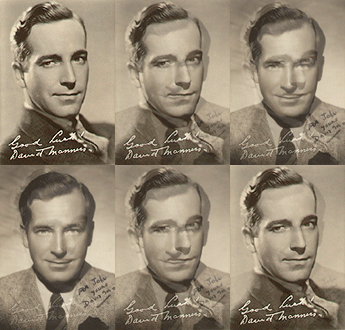
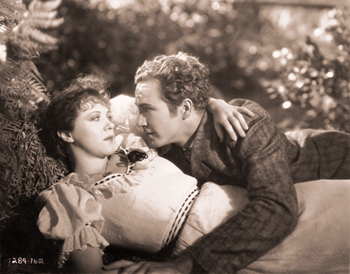
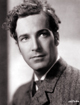
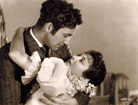
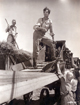
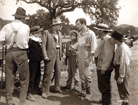
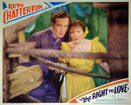
Paramount's The Right to Love is a starring vehicle for Ruth Chatterton, known at the time as "the screen's greatest dramatic actress." Based on the story "Brook Evans" by Susan Glaspell, it centers on the life of Naomi, a farm girl of the 1890's, whose family denies her the company of Joe, (DM) the love of her life. After he is killed in a threshing machine accident she marries Caleb Evans, (Irving Pichel) a man of strident religious ideals, to save her honor and goes west with him. When her daughter (Chatterton in a dual role) is grown, she reveals the identity of her true father, (DM) hoping to allow the girl the freedom she was denied. The daughter however is repelled by the news and, running to the father, becomes a missionary in China. Only in the end, when she meets a man of the world (Paul Lukas) who loves her does she appreciate her mother's life-long suffering and take "the right to love."
Regarded in 1930 as a picture with limited commercial appeal due to its Draconian subject matter and intellectual artistry, The Right to Love was lauded for its innovative use of double exposure and the fact that it was the first film to utilize the "Noiseless Recording System" developed by Western Electric. Since the inception of the talkies, ground noises and mechanical scratching had hampered sound reproduction. The new system virtually eliminated this and was soon adopted as the industry standard.
One reviewer, John S. Cohen, Jr., was particularly brutal. "Here we have a novel by Susan Glaspell adapted for the screen by Zoe Akins, who in this case has been forced to leave the Ritz or her simple but costly little castle on Lake Como and venture down the dusty roads of rather dour wheat and farm lands. You'll never believe it but they have Miss Akins writing hick drama. At any rate, The Right to Love, while it perhaps doesn't come off quite in its entirety, has something; and it will unquestionably please the love hungry wives and mothers who sob before and after La Chatterton goes into her celebrated beaten, gasping gulps. Furthermore, it presents the star in the dual role of mother and daughter, and she helps along her cause by cringing and gasping for happiness from both sides of the screen." Cohen did go on to say, "David Manners gives an excellent performance." According to The Evening World's George Gerhard, "David Manners is the best we've seen him as the young lover who comes to a tragic death." DM always had kind things to say about Ruth Chatterton and this is the only film they did together.
|